
Overview:
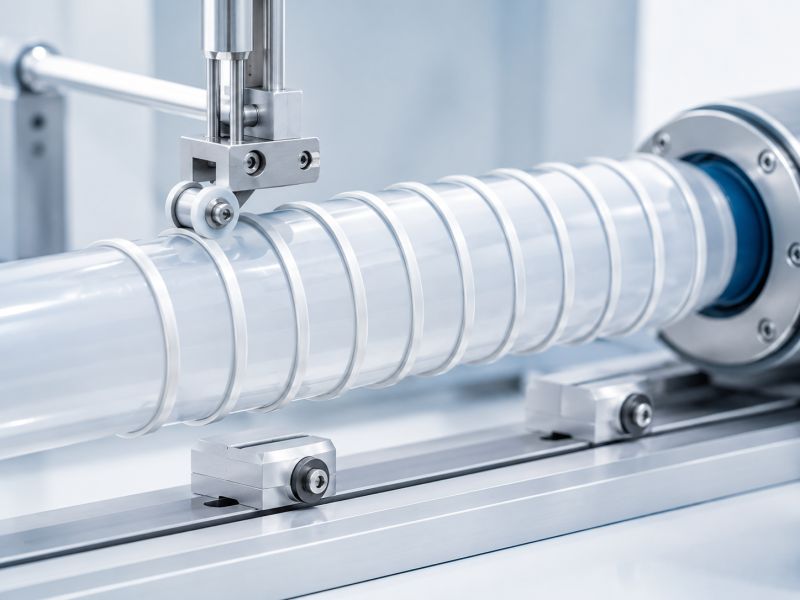
The organisation is seeking a manufacturing method or technology to install 23 heat-shrinkable compression rings/strips at pre-defined positions along a 730 mm flexible plastic tube (covered with an aluminum-foil having the heater mat underneath), providing radial contact pressure and following the substrate as it shrinks. The primary objective is a faster, lower-cost process than the current manual method; full automation is welcome but not required, and a simplified manual or semi-automated solution is equally of interest provided product quality does not depend on operator judgement.
Background:
The plastic tube is a heat-shrinkable sleeve used to seal and protect cable joints and connections. Historically, this type of product is shrunk using an open flame; the new product instead shrinks electrically, using a heater mat integrated beneath the aluminium foil. For the heater to work efficiently, it must remain in constant, even contact with the plastic sleeve throughout shrinking, including towards the end of the process as the tube reduces in diameter (shrink ratio approximately 3:1).
The compression rings/strips are the current means of holding that contact from the outside. They must apply enough radial pressure to keep the heater against the shrinking substrate, but not so much that they mark, imprint or rupture the foil, or severely mark or even collapse the tube. The underlying sleeve becomes soft when heated, so only a small amount of radial pressure can be applied. The heater is divided into several sections (around nine along its length), some requiring a different compression force, which is why two ring types are used at defined positions along the tube.
Today, the process is entirely manual and takes roughly 15 minutes per unit. An operator handles, prepares, and positions each ring by hand, then lightly pre-shrinks it with heat so it stays in place and does not rotate or misalign. The rings themselves are the main difficulty: they are cut from an endless extruded sleeve, are only about 7 mm wide, and are supplied at a large internal diameter (115 mm or 120 mm) that shrinks to 40 mm or 50 mm, respectively, on heating. In this pre-expanded state, they are thin (wall thickness 2 to 3 mm), light and flexible relative to their diameter, so they twist and deform easily and are hard to feed, grip, and place by conventional automated pick-and-place. A pre-positioning or magazine step, or a way to detect folded/misaligned rings, may therefore be needed as a preceding process step.

A further option currently being explored is to use strips of the same material as the heat shrink rings, having the same width and wall thickness. These are formed around the aluminium film, and then the ends are fixed together e.g. using an additional means like metal clamps.

The rings or the strips are not mandatory. What is required is a reliable, production-ready way to compress the assembly from the outside and follow the substrate as it shrinks. Alternative approaches that achieve the same function to the heat-shrinkable compression rings are welcome.
Requirements:
- Installation of 23 rings/strips, correctly positioned along the tube of 730 mm length to ±3 mm at defined positions dictated by the heater sections.
- Faster and cheaper than the current ~15-minute manual process. A cycle time of ~60 sec is the aspiration, but longer cycle times are acceptable where justified by lower cost/investment.
- Must reliably feed, grip and pre-position the loose, oversized rings without twisting or folding them; a preceding step to open, round or tension each ring may be required.
- After pre-shrinking, rings must sit tightly on the tube and not move during transportation. Same applies when using strips, only in case the fixing can be facilitated such that they sit tightly around the aluminium film a thermal pre-shrinking process can be avoided.
Related Tech Needs:
Seeking: Intelligent Technologies for Adaptive Digging and Loading Operations
Seeking: Technologies and Methods to Boost Construction & Operations in Gas-Oil Separation Plants
Image generated by OpenAI
